The Research Agent: for questions where probably right isn't good enough
A new agent for questions where a wrong answer costs money: contracts, prices, commitments. It researches in rounds, after Andrej Karpathy's autoresearch, with your strongest model at maximum effort. Every claim must quote its source word for word and survive a sceptical second check, and you get a plain verdict: verified, partly verified or couldn't verify.
Most questions are fine with a quick answer. "Where's the expense policy?" "Who owns onboarding?" Ask gives you the answer with its sources in a second, and if it's slightly off, you notice and click through.
Some questions are different. What notice period did we agree with this customer? Which price did we promise for next year? Are we allowed to name this client as a reference? A wrong answer here costs money or trust, and AI models sound just as confident when they're wrong as when they're right.
For those questions there's now the Research Agent. It's slower and more expensive than Ask, on purpose: it only tells you what it could check.
Karpathy's autoresearch, applied to a question
Andrej Karpathy published autoresearch: an AI agent that runs experiments on its own. It makes a change, measures the result against a fixed metric, keeps the change if the number improved, throws it away if it didn't, and goes again.
We used that loop before, on Groundtruth itself: it tuned the search that finds sources for Ask. On our fixed test set the score went from 0.742 to 0.974. On questions we wrote before tuning and never tuned on, it went from 0.808 to 0.867. The second number is the honest one, and it's why we like the method: it keeps only what measurably works.
The Research Agent applies the same loop to a single question. The metric is simple: does this claim survive checking? Claims that do are kept. Claims that don't are thrown away, with the reason, and the next round goes looking for what's still missing.
How it works
- Plan. It splits your question into the parts a complete answer needs, and plans searches for each, including searches for sources that might contradict the obvious answer.
- Read. It reads whole sources, not snippets: pages, decisions and records. If you have private pages, it reads those too, for you only. A quote out of context is how answers go wrong.
- Draft. The strongest model of your AI supplier, at maximum effort, writes the answer as atomic claims: one fact per claim, each backed by exact quotes from its sources.
- Check, in code. Every quote must appear in its source word for word, and every number in a claim must appear in its quotes. A model can argue its way past a model. It can't argue its way past a string comparison.
- Check, sceptically. A second, separate call reads each claim, its quotes and all the sources, with one job: find reasons the claim isn't fully supported. Wrong context, a different plan or period, a draft, another source that says otherwise.
- Repeat. What survived is kept. What's missing becomes the next round's searches. It stops when the answer is complete, or after the number of rounds you set (three by default, at most five).
A verdict, decided in code
You don't get a confident paragraph. You get one of three verdicts, and the rules are code, not a model's judgement:
- Verified: the answer to your question passed every check, nothing is missing, no sources disagree, and nothing rests on a page nobody has reviewed or that's out of date.
- Partly verified: the claims shown passed every check, but something's missing, sources disagree, or a source still needs a person's review. It tells you which.
- Couldn't verify: no answer survived. You see what it could establish and what it couldn't, never a guess. Unless the question is about yourself, it goes on your team's list of knowledge gaps, so someone writes the page.
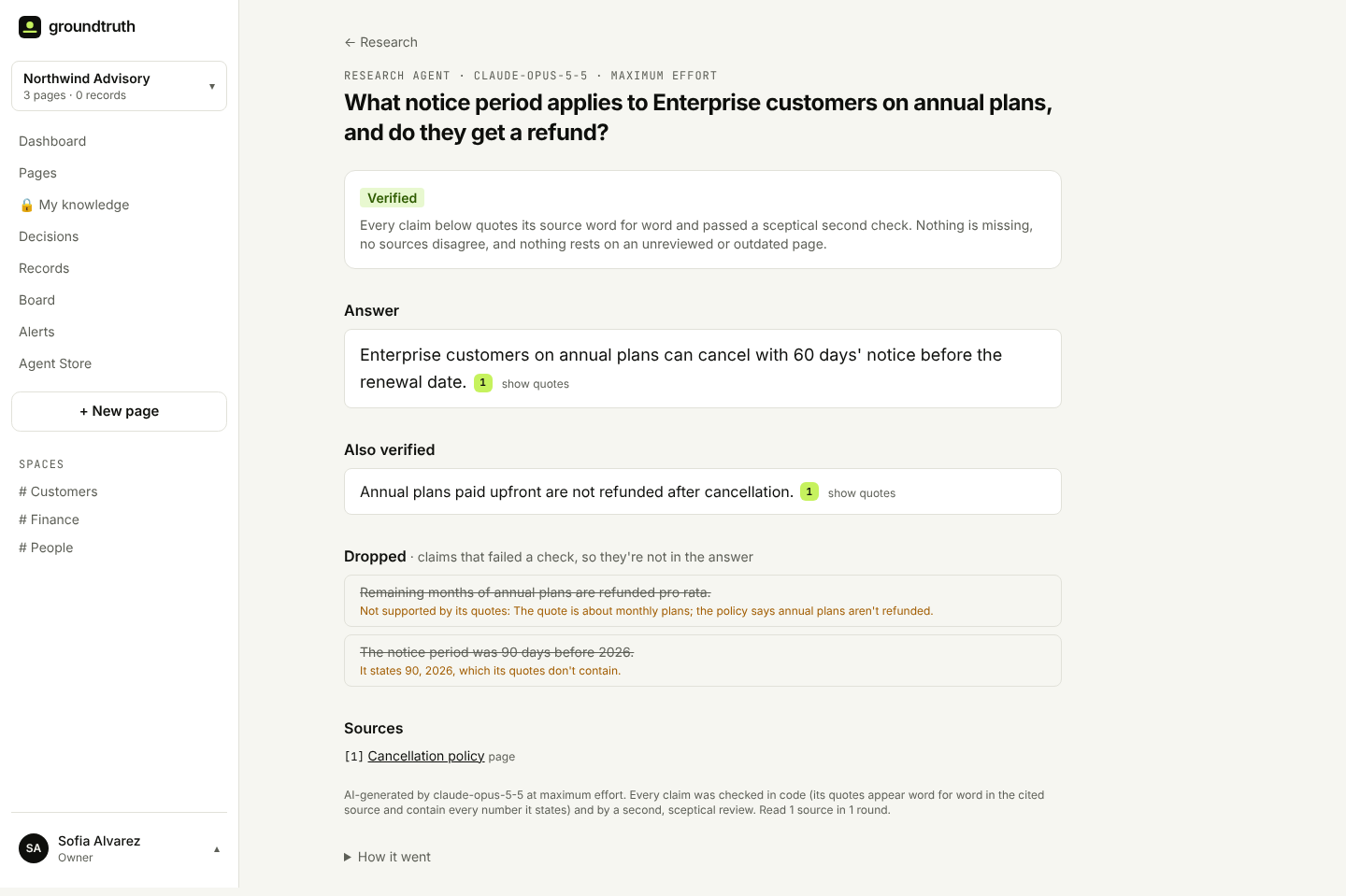
The claims it threw away are listed too, with the reason. In this test run on a demo workspace (the screenshots in this post come from it), it dropped a claim that "the notice period was 90 days before 2026", because neither number is in the quote it gave. It also dropped "annual plans are refunded pro rata", because that quote is about monthly plans:

That last check is something Groundtruth can do and a general AI assistant can't: it knows which pages a person has verified, which ones an AI wrote and nobody checked, and which haven't been looked at in 90 days.
Using it
Install the Research Agent from the Agent Store. It needs your workspace's own AI key, because it runs the heaviest model at maximum effort, several calls per question.
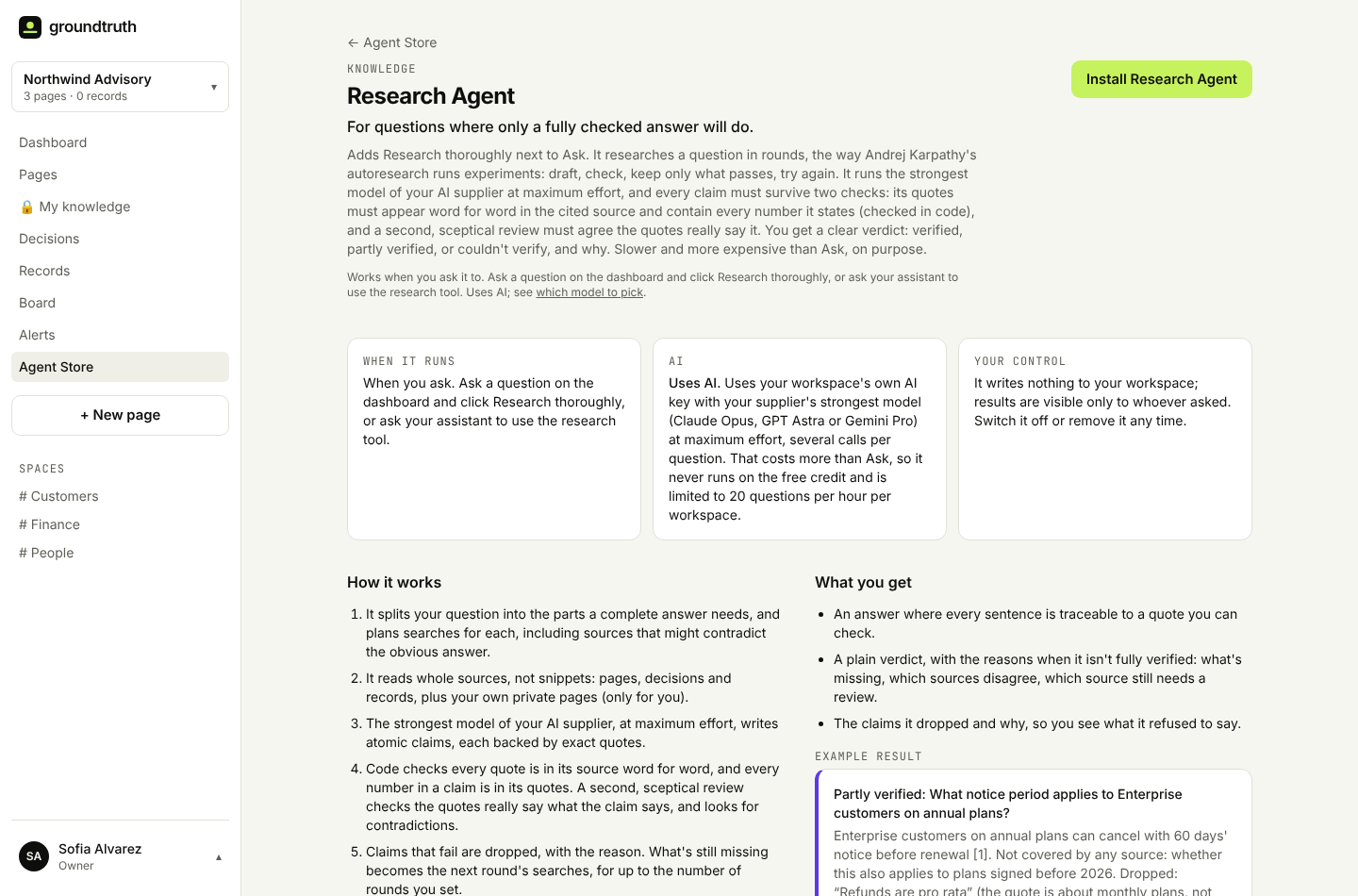
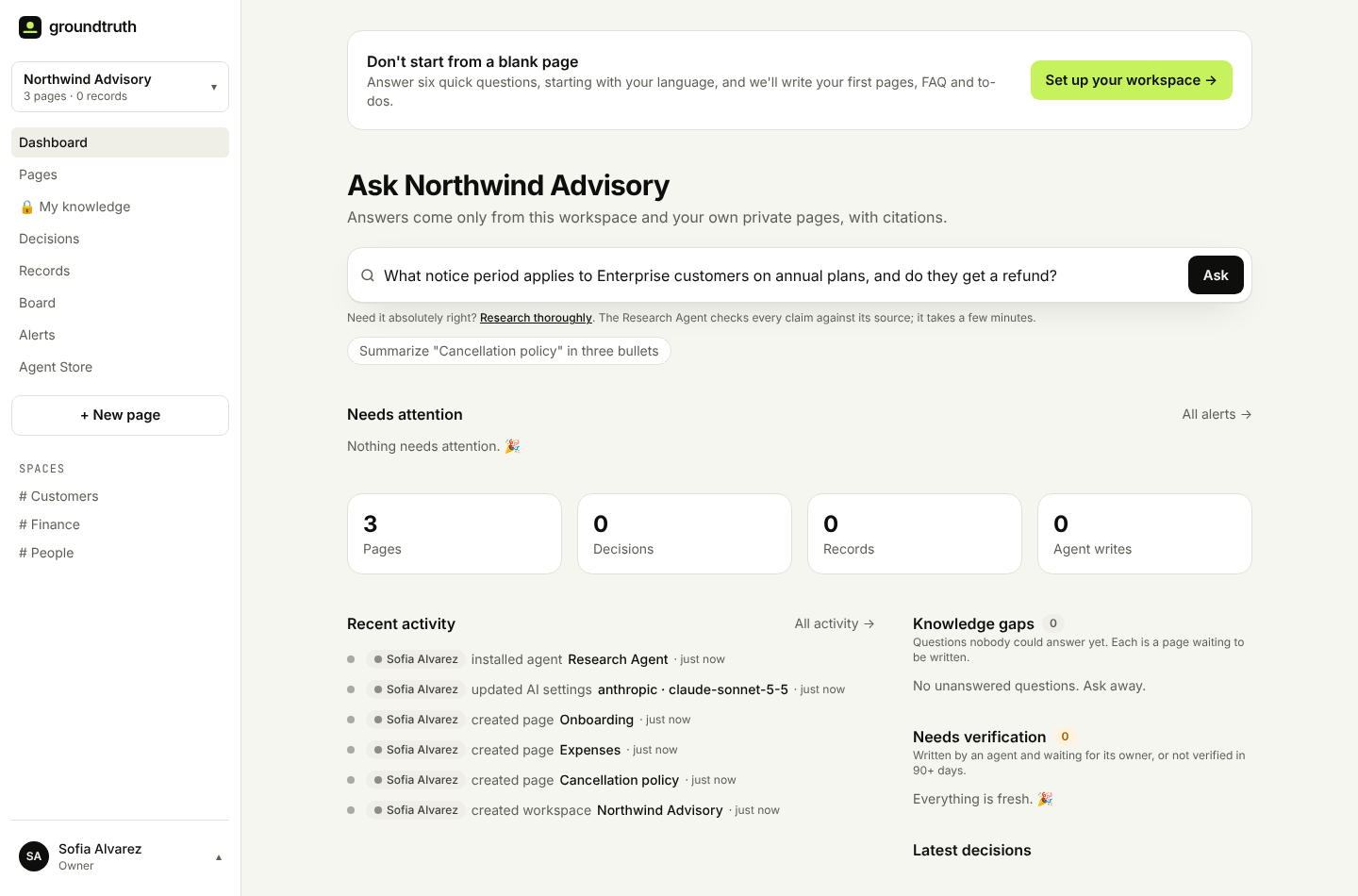
Then type your question under Ask and click Research thoroughly:
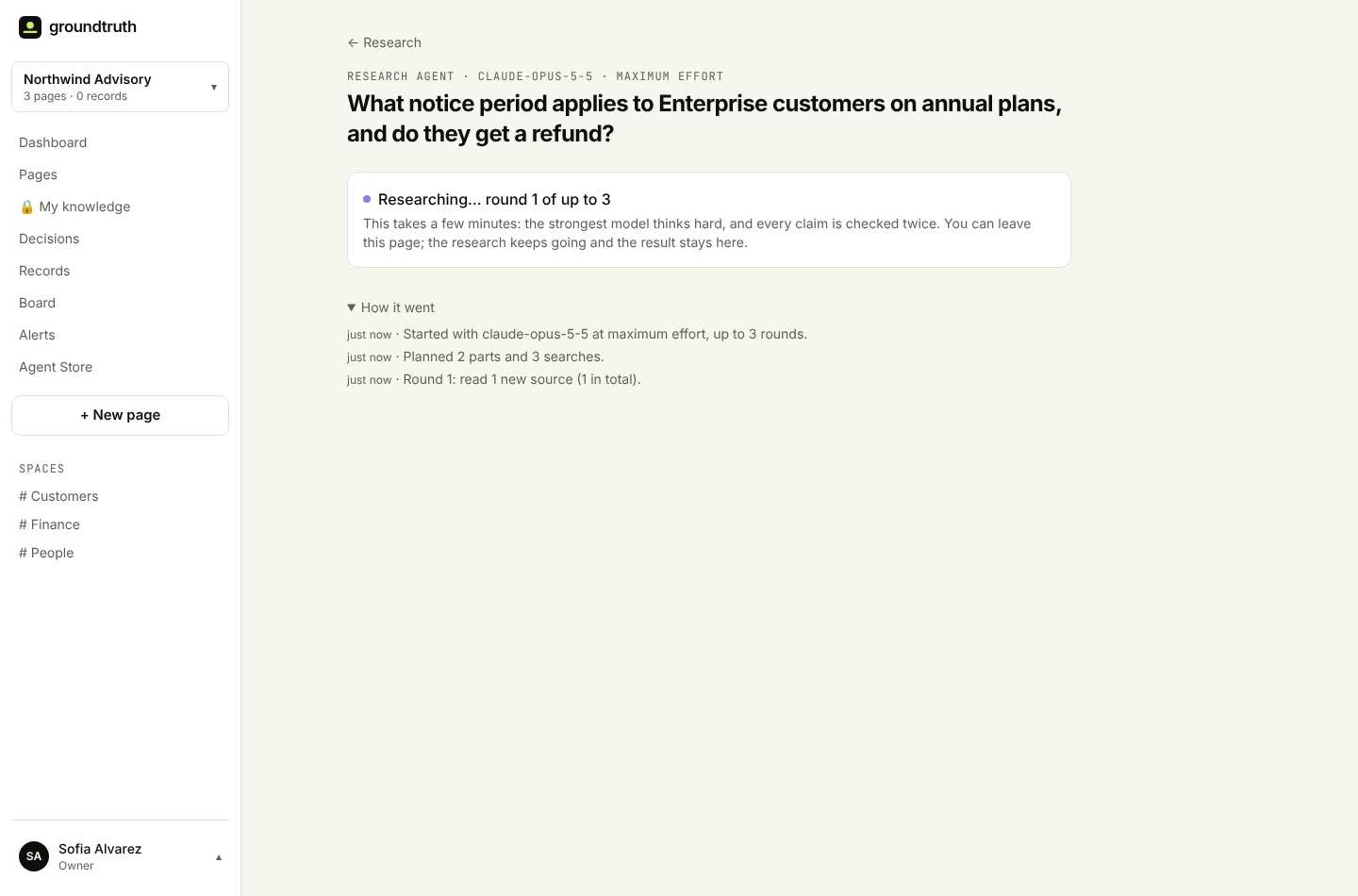
It takes a few minutes. You can watch it work, or leave: the research keeps going, and the result stays on its page.
Your assistant can use it too. The research tool starts it and get_research collects the result, so Claude can hand off the questions that matter and come back with the verdict and its reasons.
What it costs, and what it doesn't promise
- Heavier, on purpose. It uses your supplier's strongest model (Claude Opus, GPT Astra or Gemini Pro) at maximum effort, for several calls per question. Expect a few minutes and noticeably more tokens than Ask. You can choose fewer rounds, or the workspace's own model.
- Your key only, with a limit. It never runs on the free AI credit, and it's limited to 20 questions per hour per workspace.
- Private stays private. It can use your private pages, so only you can see your research. Each person keeps their latest 20; older ones are deleted.
- Verified means supported by your sources, not true in the world. If a page is wrong but a person verified it, the Research Agent will quote it faithfully. It makes answers exactly as reliable as your knowledge base, and tells you where your knowledge base is weak.
Try it
Install the Research Agent from the Agent Store, add your AI key under Settings → AI, and ask it the question you'd least like to get wrong. The details are in the docs. Tell us what it found, or what it refused to say, at hello@groundtruthhq.tech.