Day eleven: what Groundtruth does now, and what comes next
We started Groundtruth eleven days ago. Here's everything it does today, from cited answers and AI agents to meeting notes, a knowledge base that keeps itself whole and private pages. And why next week we stop building and start finding the people it's for.
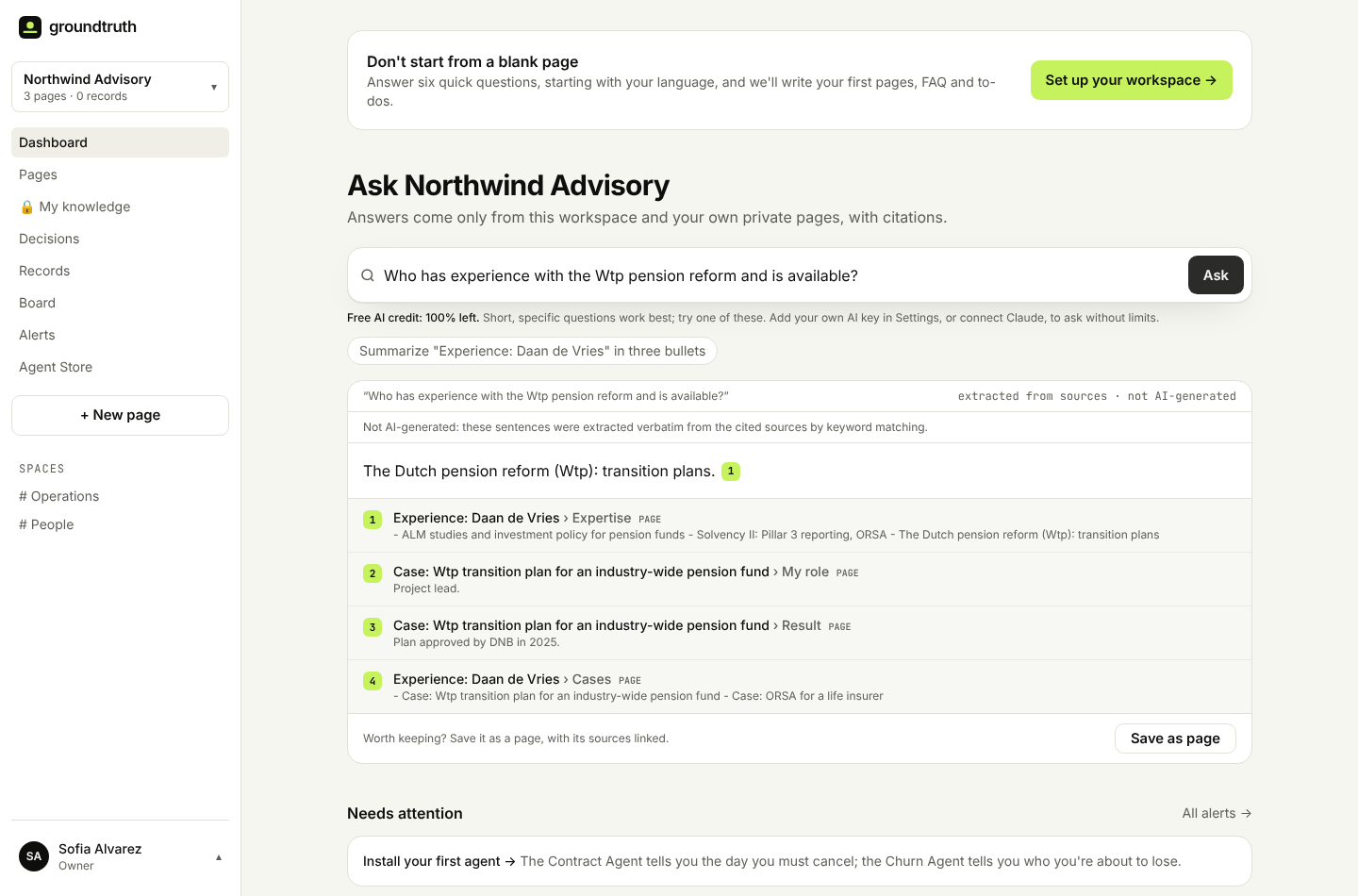
We started Groundtruth on 6 October with one idea: your company's knowledge should be something your team and your AI assistants can ask questions of, and trust the answers.
Eleven days later, that idea is a product. Here's what it does today, what we learned building it, and what changes next week.
The short version
Groundtruth is where a company writes down how it works (pages), why it works that way (decisions) and the facts (records). You ask it a question in plain language and get an answer that cites its source. Your AI assistants ask it the same questions, and get the same cited answers.
That's the core. Everything else we built in the last eleven days is about three things: getting knowledge in without effort, keeping it true, and letting AI work with it safely.
Ask, and see where the answer comes from
Every answer cites the pages, decisions and records it came from, and tells you plainly how it was made: written by an AI model, or extracted word for word. If nothing in your workspace answers the question, Groundtruth says so instead of guessing, and the question goes on a list of knowledge gaps: the pages your team should write next.
Your AI assistant, connected
Groundtruth speaks MCP, the open standard AI assistants use to reach tools. That means:
- Claude: Groundtruth is in Claude's connector directory. One click, sign in, done.
- ChatGPT and Gemini connect the same way, and so does any MCP client. Every tool is also a plain REST endpoint.
- One sign-in, several workspaces. Pick which workspaces an assistant may use. It says which one an answer came from.
- Slash commands. In Claude,
/ingesttakes a meeting, an email or a link and proposes updates to every page it touches. You review the changes as a diff and accept or reject each one.
Everything an AI writes is labelled as AI-written and waits for a person to check it. Nothing an agent does is invisible: the activity log shows who changed what, human or agent.
Getting knowledge in, without the chore
The reason wikis die is that writing them is work. So we made most of the writing come from things you already do:
- Groundtruth Capture for Chrome saves the page you're reading, or a selection, as a page. It's available from your dashboard today, and soon in the Chrome Web Store.
- Wispr Flow and Plaud: your meeting notes and recordings, filed as pages automatically, with the summary, the decisions and a link back to the recording.
- Start from your website. A new workspace can read your public site and write the first pages, FAQ and to-dos for you.
- Write mode for long documents, and the Structure Agent to turn a messy page into a clear one.
A knowledge base that keeps itself whole
Inspired by Andrej Karpathy's LLM wiki, we added what keeps a knowledge base useful after month one:
- Page links with
[[Page title]], and every page shows what links to it. - An index and an agent handbook, so assistants know your conventions the moment they connect.
- Saved answers: a good answer becomes a page with one click.
- The Freshness Agent flags pages nobody has checked in a while, and the Librarian Agent finds broken links, duplicates and questions people keep asking.
Agents that do actual work
The Agent Store has five agents and two integrations. The Contract Agent tells you the day you must cancel a contract. The Churn Agent tells you which customers you're about to lose, before they tell you. Their alerts go to a person, or to your Slack. And the board gives work to people and agents alike, with a clear line: agents move cards to review, people mark them done.
Private knowledge, inside the company
This week's biggest addition: My knowledge. Every member gets private pages: notes, 1:1s, your experience, your cases. When you ask a question, the answer uses them too, but only for you. Not your colleagues, not the workspace owner, not the workspace's agents.
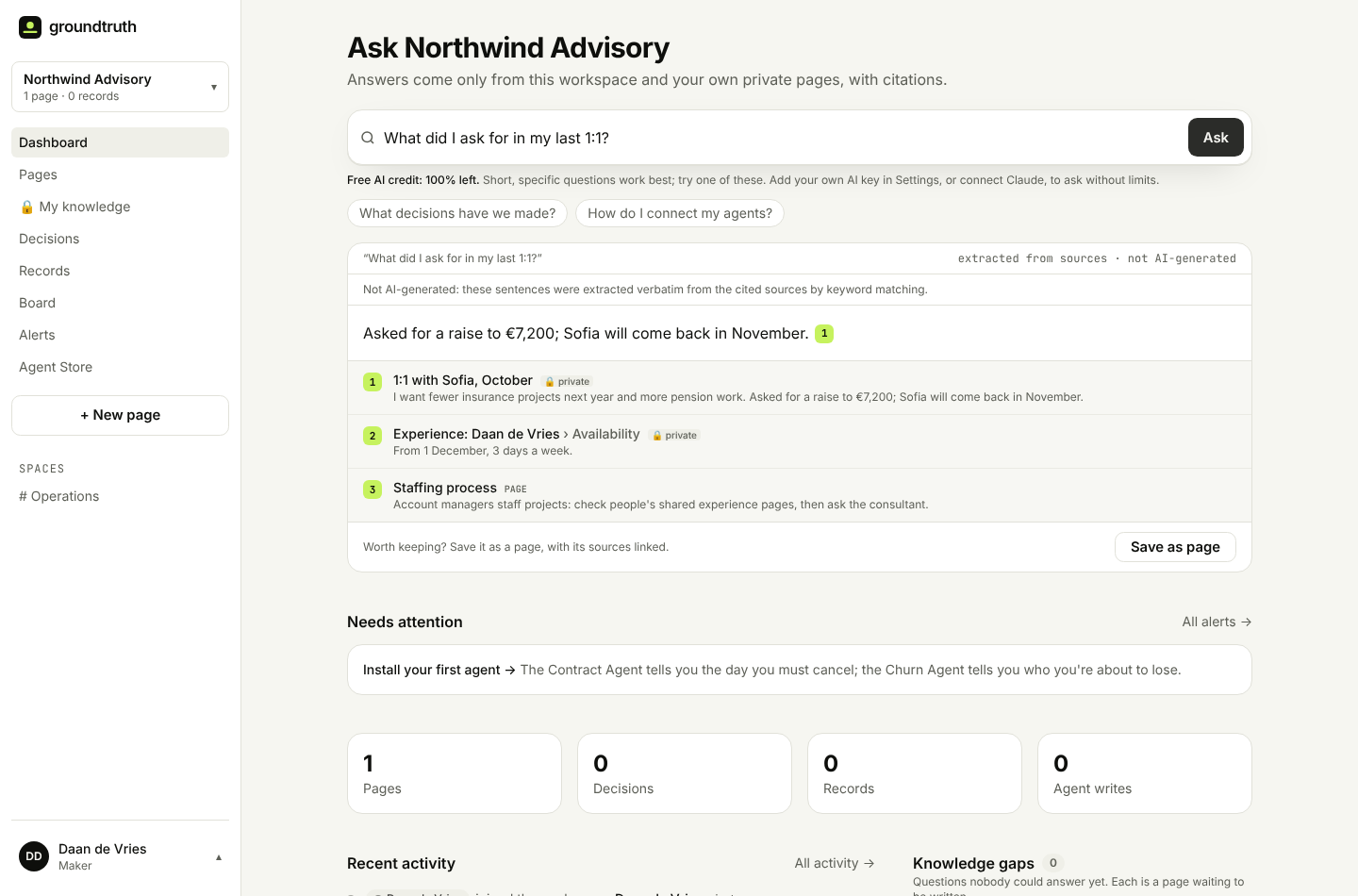
When others should see something, you choose who: specific colleagues, or everyone. At a consulting firm, that's the difference between an account manager guessing who fits a project and asking Groundtruth, which finds the experience pages consultants chose to share, and nothing they didn't.
The boring parts we didn't skip
- Roles: Readers, Makers and Owners. Invite links expire, and are single-use unless you choose otherwise.
- History: every page keeps its last ten versions, and deleted pages sit in the trash for 30 days.
- Downloads: every page as PDF, Word or Markdown.
- AI transparency: every AI-written answer is labelled as such and carries a signed marker, ahead of the EU AI Act's transparency rules.
- Privacy: questions are stored without who asked them, and private pages are stored apart from the workspace.
- Languages: workspaces can be set up in English or Dutch, with starter pages, templates and the agent handbook in either. This site speaks both.
In numbers: 76 commits, 23 changelog entries and 187 automated tests that run on every change. Bring your own AI key, or use the free AI credit every new workspace gets.
What we learned
Trust is the product. The features we're proudest of share one shape: show the source, label what AI did, let a person decide. Every time we were tempted to let AI just change things, we added a review step instead.
Knowledge has to arrive by itself. A great editor isn't enough; nobody wants another place to write. That's why so much of this week went into Capture, the meeting integrations and /ingest: ways to get knowledge in without sitting down to write.
Not everything belongs to everyone. We built a shared company brain first. Then we realised half of what people know is personal, or for a few colleagues only. Private pages make the shared part more useful, not less.
Next week: fewer features, more people
For eleven days we built. Next week we change focus: getting Groundtruth into the hands of the teams it's for. That means:
- Talking to teams, especially consulting firms, agencies and other knowledge businesses where finding "who knows this?" costs real money.
- Making the first ten minutes great. We'll watch new teams sign up, note every place they hesitate, and fix it the same day.
- Being easy to find: the Chrome Web Store, AI assistant directories, and search, in English and Dutch.
- Building only what new users ask for. The roadmap is now theirs.
Try it, or tell someone who should
Groundtruth is free to start: create a workspace, connect your assistant, and ask it something about your company. If you know a team that keeps answering the same questions over and over, send them this post.
And tell us what you think, good or bad, at hello@groundtruthhq.tech. Next week, every reply gets read by the people building it.